
Home / Delrin 4D™ / Breakthrough CO2 Reduction
For marketing demonstration only
An all-Delrin autoinjector can drive enhanced sustainability differentiation and opens realistic recyclability options.
Sustainable Features of Delrin 4D™ :
- Eco-design – using less material by integrating design features into single components and thinning wall sections
- Use of inherently low GWP Delrin, further enhanced with inclusion of Delrin Renewable Attributed (RA) grades
- Reduced shipping complexity and consolidation of deliveries
- Low effort disassembly and easier separation versus mixed material devices
- Potential to re-use components
Delrin 4D™: Carbon Study
Comparison of Device CO2 Footprint
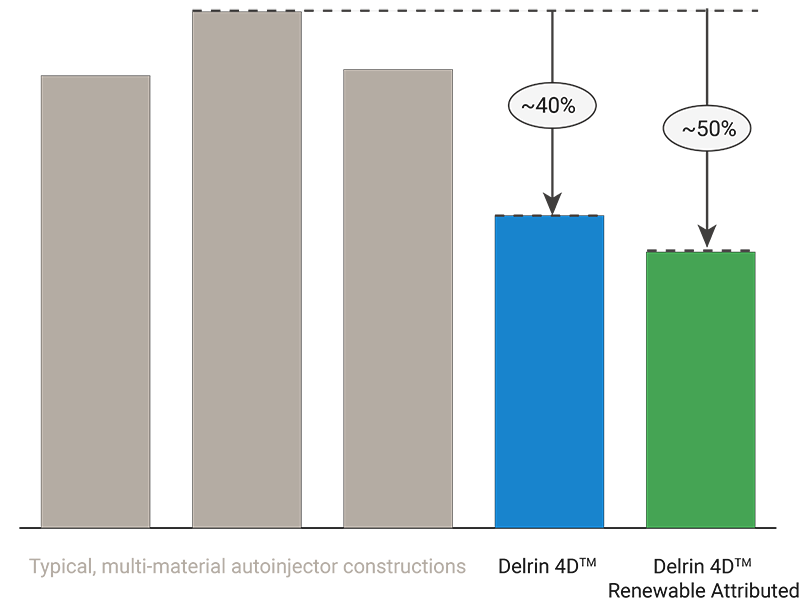
By combining eco-design principles with the inherently low GWP of Delrin, the Delrin 4D™ device achieves 40-50% CO2 reduction per device in a cradle-to-grave analysis.
Benchmarking the Delrin 4D™ all-Delrin construction against multi-material constructions confirms that selecting materials with mechanical property advantages enables 4-6% material reduction with Delrin-only parts.
Key to the CO2 footprint breakthrough is the re-imagination of the widely-accepted two-spring design. Replacing one of the metal springs with Delrin leads to >60% GWP savings for a single component.
Incorporating Delrin® Renewable Attributed (RA) grades unlocks the potential for further GWP savings.
Device LCA Assessment
Global Warming Potential (GWP), g CO2 e
Cradle to grave analysis, end of life: high temperature incineration scenario
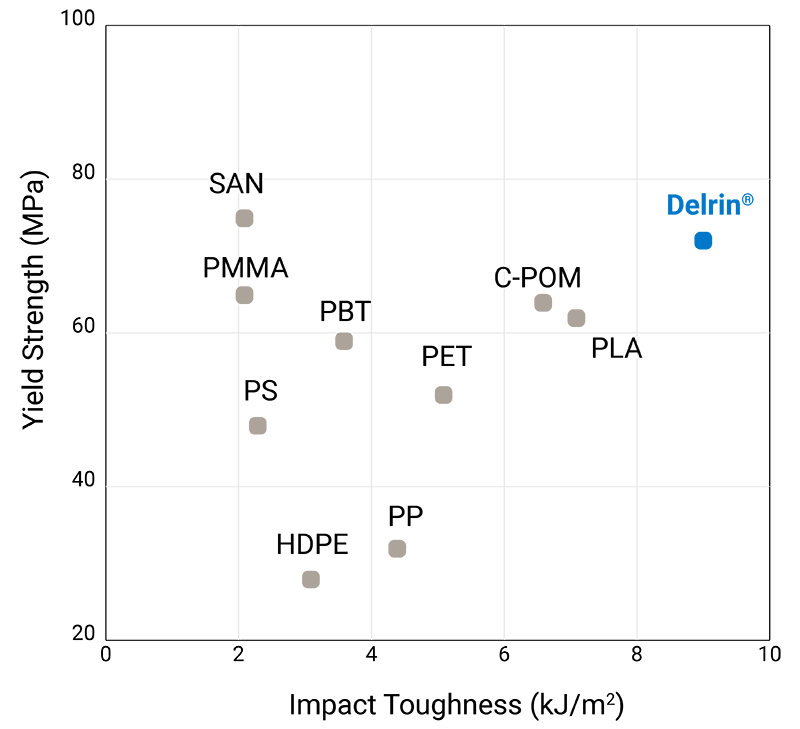
Material Properties Comparison
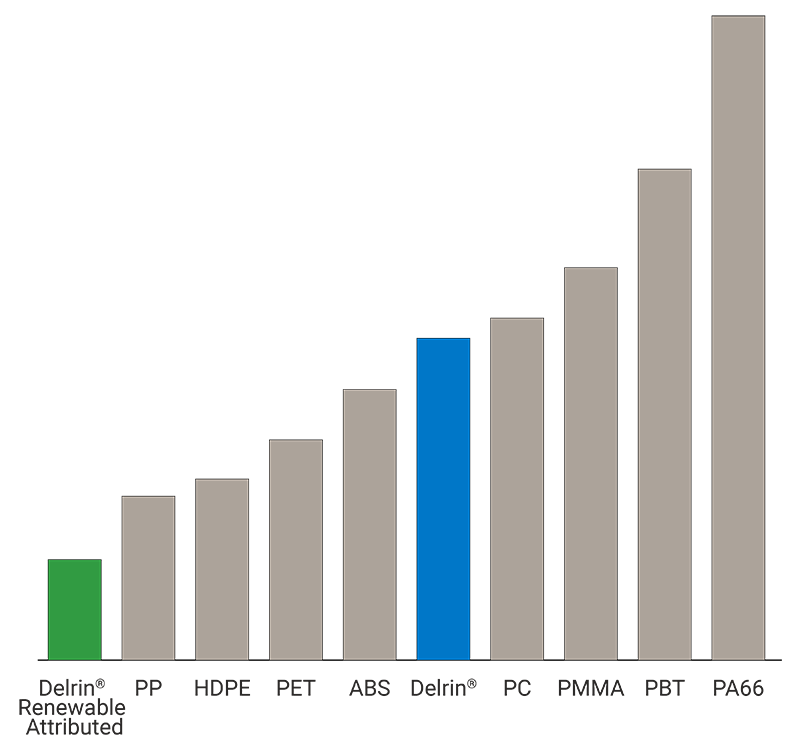
Product Carbon Footprint: Cradle to Gate
The superior mechanical properties of Delrin acetal homopolymer enable thinner wall sections, reducing overall material use.
Delrin has inherently low GWP, with further improvements possible through inclusion of bio-based Delrin Renewable Attributed (RA) grades.
Delrin® Renewable Attributed
Delrin® Renewable Attributed is produced using 100% bio-feedstock from waste according to ISCC (International Sustainability and Carbon Certification) mass balance certification, contributing >50% reduction in GWP versus fossil-based Delrin grades.
In addition, these grades offer full equivalency and are considered a true drop-in alternative to existing Delrin grades.

End-of-Life
Facing the challenge with Delrin 4D™
As the single-use injection device market continues to expand, there’s a pressing need to collaborate along the value chain to address accumulating waste and find means for disposal beyond incineration and landfill, both of which contribute to increased carbon emissions and waste of valuable materials.
As a mono-material device, Delrin 4D™ enables easier separation at end-of-life, unlocking possibilities for open-loop and, eventually, closed-loop recycling.
In addition, the robust nature of Delrin components introduces the possibility for remanufacturing, bringing second-life benefits to individual components.
Disassembling the Delrin 4D™ device
Enabling Circularity: Simplified Material Recovery with Delrin 4D™
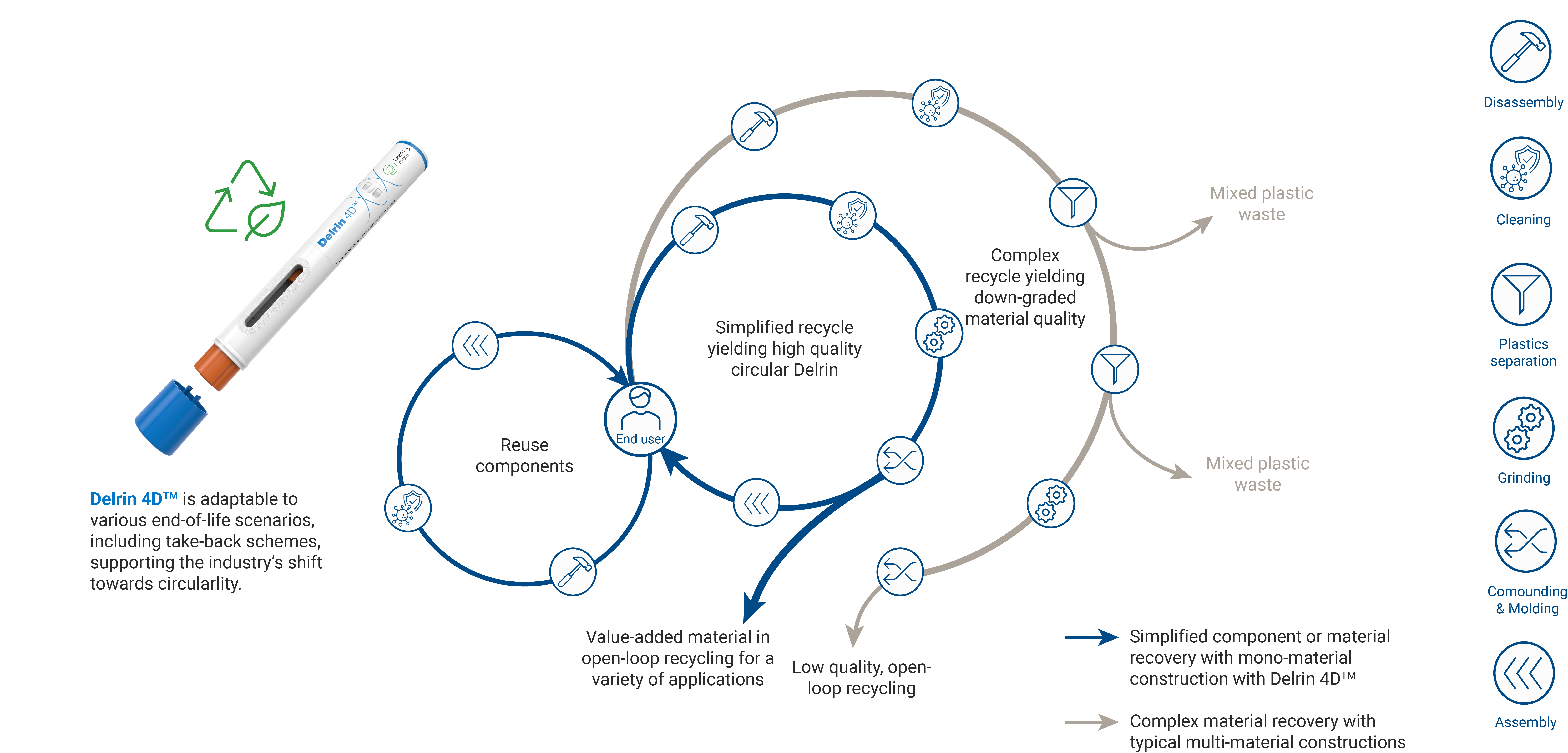
Disassembly includes the separation of the primary container and needle which subsequently become high-temperature incineration waste.
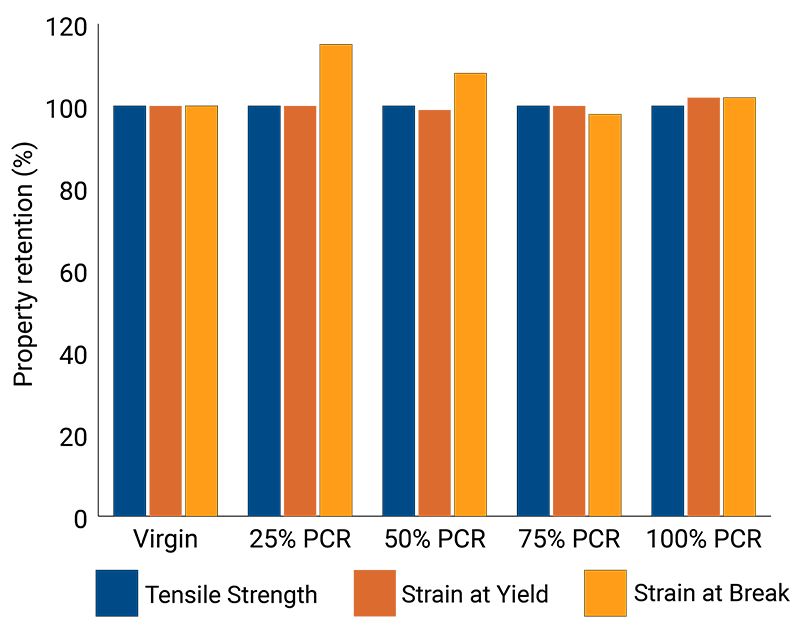
Mechanical recycling
Delrin parts can be re-ground and re-processed, results indicate excellent property retention with 100% post-consumer recycle (PCR) content.