
PDF text
Delrin® Solution Series
Creep and Stress
Relaxation
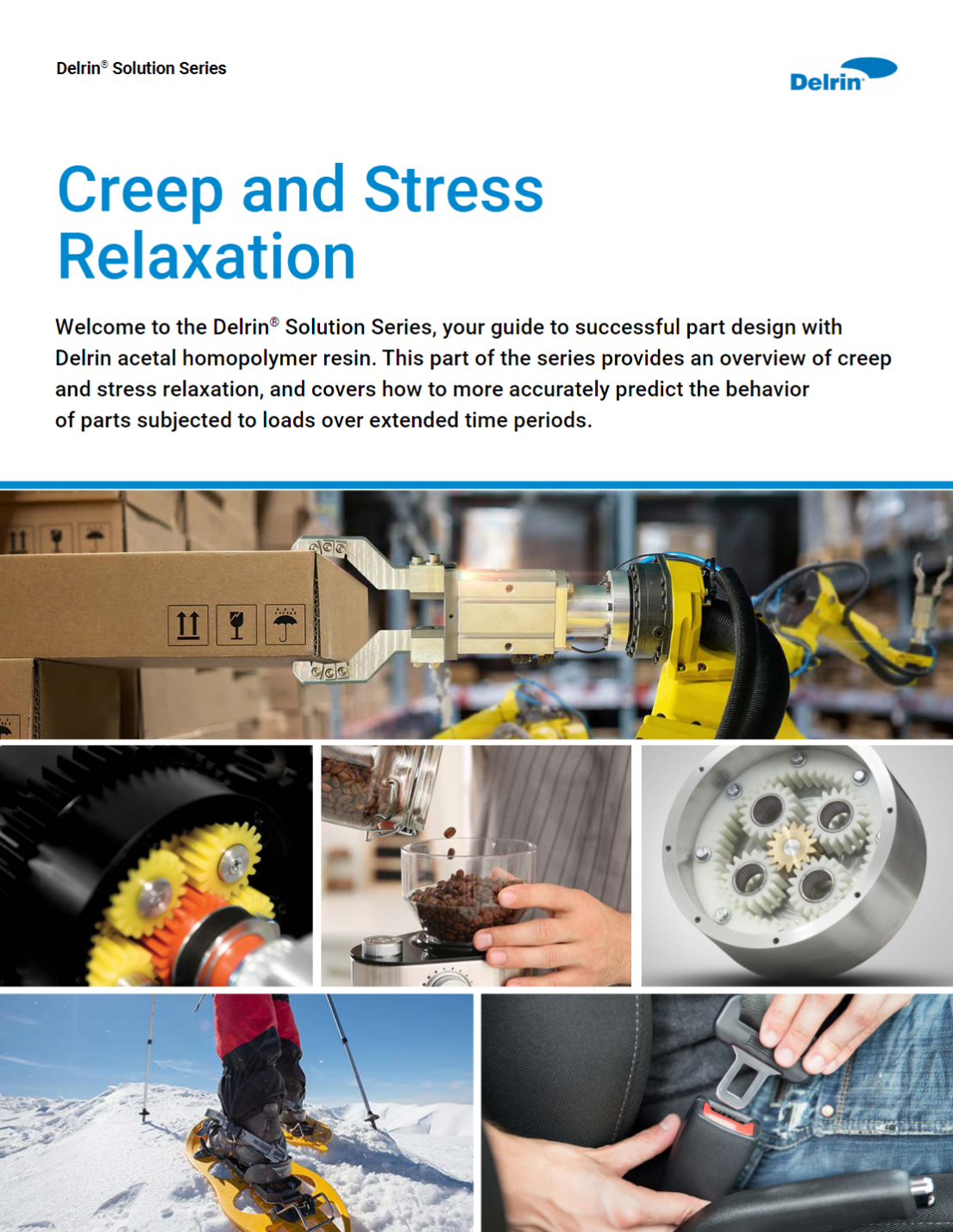
Welcome to the Delrin® Solution Series, your guide to successful part design with
Delrin acetal homopolymer resin. This part of the series provides an overview of creep
and stress relaxation, and covers how to more accurately predict the behavior
of parts subjected to loads over extended time periods.
Delrin® Solution Series | Creep and Stress Relaxation
What’s Inside
Understanding creep with plastic........ 3
Why plastics creep............................. 3
Creep and relaxation:
what’s the difference?......................... 3
Looking at a real part.......................... 5
Creep with Delrin®.............................. 6
Accelerating creep............................. 7
Studying the unloading of a part......... 7
Summary............................................ 7
Delrin® Solution Series | Creep and Stress Relaxation
Creep and relaxation: what’s the difference?
Creep occurs when you subject a part to a constant load,
producing an initial deflection followed by a slow increase in
strain with time.
Stress strain at time 0
Stress (S), MPa (psi)
Stress strain at x00 hours
Creep
Modulus
Increase in deflection
with time
Understanding Creep with Plastic
eT
e0
Strain (e), mm/mm (in/in)
The aim of this article is to improve your understanding
of plastics behavior under long-term loading. If you
Figure 1. Stress-strain curve showing creep
subject a plastic part to a load over an extended period,
you must consider the creep or relaxation that will occur,
Source: DuPont
If you’re designing a part subject to a long-term load, use a
creep modulus of the material. This provides an indication of the
material behavior at any point in time following loading.
and how it will result in either increasing deflection or
reducing transmitted force.
When you remove the load, the deflection is not fully recovered,
resulting in a permanent set. This behavior is demonstrated with
a spring example in an upcoming section.
Why plastics creep
Creep with polymers is a viscoelastic effect due to such materials
possessing both viscous and elastic behaviors.
Stress relaxation occurs when a part is subjected to a constant
strain over time. An example is a spring held in a compressed
form. Over time the modulus decreases and, as in the spring
example, this reduces the force it can apply.
Elastic behavior is the ability of the material to recover its original
shape once a force is removed.
Viscous behavior is a measure of a material’s resistance to flow.
For example, water flows more easily than syrup because it has
a lower viscosity. Higher-viscosity materials might include honey,
syrups or gels – these will flow at a much lower rate, but any
flow becomes a permanent effect. Polymers have an even higher
viscosity and therefore show even greater resistance to flow.
However, when you apply a prolonged load to a polymer, they
too will demonstrate a permanent set behavior, which is often
referred to as creep.
Stress (S), MPa (psi)
S0
Creep happens in polymers because of their structure.
They are made up of long molecular chains that are tangled
together with weak bonds between them. When a load is applied,
these chains can gradually straighten and slip over each other,
remaining fixed in place when the load is removed.
Stress strain at time 0
Reduction
in load over
time
ST
Stress strain at x00 hours
e0
Strain (e), mm/mm (in/in)
Figure 2. Stress-strain curve
showing stress relaxation
Source: DuPont
Delrin® Solution Series | Creep and Stress Relaxation
Creep and relaxation: what’s the difference? (continued)
Creep and relaxation rates will vary with material composition, temperature, stress level and moisture content. When validating a
new part design, it is impossible to assess creep and stress relaxation performance in real time and under all conditions due to the
timescales involved. Consequently, designs must incorporate the estimated creep behavior of a particular resin under the load and
environmental conditions expected. The more accurate the data, the better the design.
Creep data is often presented in the form of isochronous stress-strain curves versus time at a particular temperature.
From these charts, you can estimate the increase in strain for a part under constant stress or the reduction in force for constant strain.
2.5
0,
3,000
2.0
1.0
0.5
Delrin® 100, 500, 900
2,500
Creep modulus MPa
1.5
Stress level, 103 psi
Stress level, MPa
3.0
pr
oj
ec
te
d
hrs
1,00
0h
rs
5,0
hrs
10,
0h
rs
1 hr
10 h
rs
It is also possible to convert the data into a modulus versus time graph, which shows that while creep is a long-term effect, it occurs
at a faster rate during the first 100 hours.
2,000
Delrin (DMA)
1,500
1,000
0.5
1.0
1.5
2.0
2.5
2,000
4,000
6,000
8,000
10,000
Time Hrs
Total Strain, %
Figure 3. Delrin® isochronous
stress-strain curves vs. time
Source: DuPont
Figure 4. Modulus of Delrin® 100 vs. time at
23°C and constant stress of 10 MPa
Source: DuPont
Delrin® Solution Series | Creep and Stress Relaxation
Looking at a real part
Let’s look at what happens when a spring is
compressed by a constant load. There is an initial
deflection, followed by further compression over
time. When the load is removed, there will be a
reversal of the initial loading phase and some
recovery but not back to its original position. This is
called permanent set.
Figure 5. Spring compressed with a constant
load of 5N
Source: DuPont
1.6
Compression mm
1.4
For a spring compressed with a constant load of 5N,
the initial deflection is 0.8mm followed by increasing
deflection over 1,000 hours up to 1.4mm.
1.2
Removal
of load
1.0
0.8
If the spring is compressed and held in the same
position, it applies a reaction force to the object that is
compressing it. This reaction force will decrease over
time due to relaxation.
0.6
0.4
0.2
1,000
Time Hrs
Figure 6. Displacement-time spring demo
Source: DuPont
Time in h Delrin®
PBT
PA66
Delrin® Solution
Series | Creep and2269.29
Stress Relaxation
1070.89
2307.692
736.892
1428.571 1123.39
789.474
587.911
1071.429
®
Creep with Delrin
467.384
731.7073 555.556
Creep modulus MPa
Creep Modulus - MPa
2,500
2,000
1,500
Delrin
Delrin
1,000
PBT
PBT
PA66
PA66
2,000
4,000
6,000
8,000
10,000
Time
- Hours
Time
Hrs
Source: DuPont and Campus Plastics
Figure 7. Creep modulus at 10 MPa stress
A similar effect can be seen by comparing
Delrin® 311DP acetal homopolymer (one of
the stiffest acetals) with a similar viscosity
copolymer acetal.
Because it is stiffer, Delrin deflects less when
first loaded. Although both materials creep
at a similar rate, Delrin maintains its initial
advantage. In this case, Delrin creeps 20%
less under load at any given time.
To think about it another way, Delrin takes
over ten times longer to reach a critical
deformation point. This is a key performance
parameter for a part like a shelf bracket.
2.5
High MW Copolymer 20.7 MPa
311DP NC010 20.7 MPa
2.0
>20% lower creep
at a given time
1.5
Strain %
While unfilled materials might creep at
similar rates, the initial stiffness of a material
indicates its real usability. When Delrin is
compared to PBT and PA66 (Cond), the
modulus of Delrin is significantly higher than
the other materials throughout the lifetime of
the test.
>1,000% longer life
at a given strain
1.0
0.5
1,000
10,000 100,000 1,000,000
Time Hrs
Source: DuPont
Figure 8. Comparison of creep performance
Accelerated Flexural Creep at 23°C using DMA. For reference purposes only.
Figure 9. Shelf bracket
Delrin® Solution Series | Creep and Stress Relaxation
Accelerating creep
Studying the unloading of a part
Creep is an effect of time. So when validating a new product or
part design, you will want to accelerate the process by testing at
an elevated temperature for a shorter period of time.
Additional research suggests that a part immediately recovers
when a load is removed followed by an additional slower recovery
due to the viscoelastic response of the material.
This means there is a less permanent set than traditional
creep theory suggests.
Creep testing has been conducted on several Delrin® grades at
25°C, 40°C, and 60°C to measure how much faster creep takes
place at elevated temperatures. This helps you estimate the
acceleration factor when specifying a test procedure.
Summary
Each individual case of part design is unique due to variables
like stress level, time, temperature, unloading, etc. We are here
to help. If you are designing a part under long-term load, contact
your Delrin representative to access the wealth of data and
understanding available.
In addition to accelerating creep, raising the temperature
reduces the modulus of the material. If further testing after
creep will take place at room temperature, it is important to
understand the recovery when the temperature is lowered.
To learn more, contact your Delrin representative or visit Delrin.com.
Delrin® is an industry-leading premium industrial polymer business. Grounded in strong innovation, Delrin is a category creator with a longstanding
reputation for quality, reliability, supply and product performance. The iconic Delrin brand, coupled with proprietary technology and deep application
expertise make us a leader in the high-end engineering polymer market. Delrin has exciting growth prospects from exposure to automation, actuation,
healthcare, mobility and consumer applications.
Copyright 2023 Delrin®
Form No. HMC1223