
PDF text
Delrin® Solution Series
Fatigue Endurance
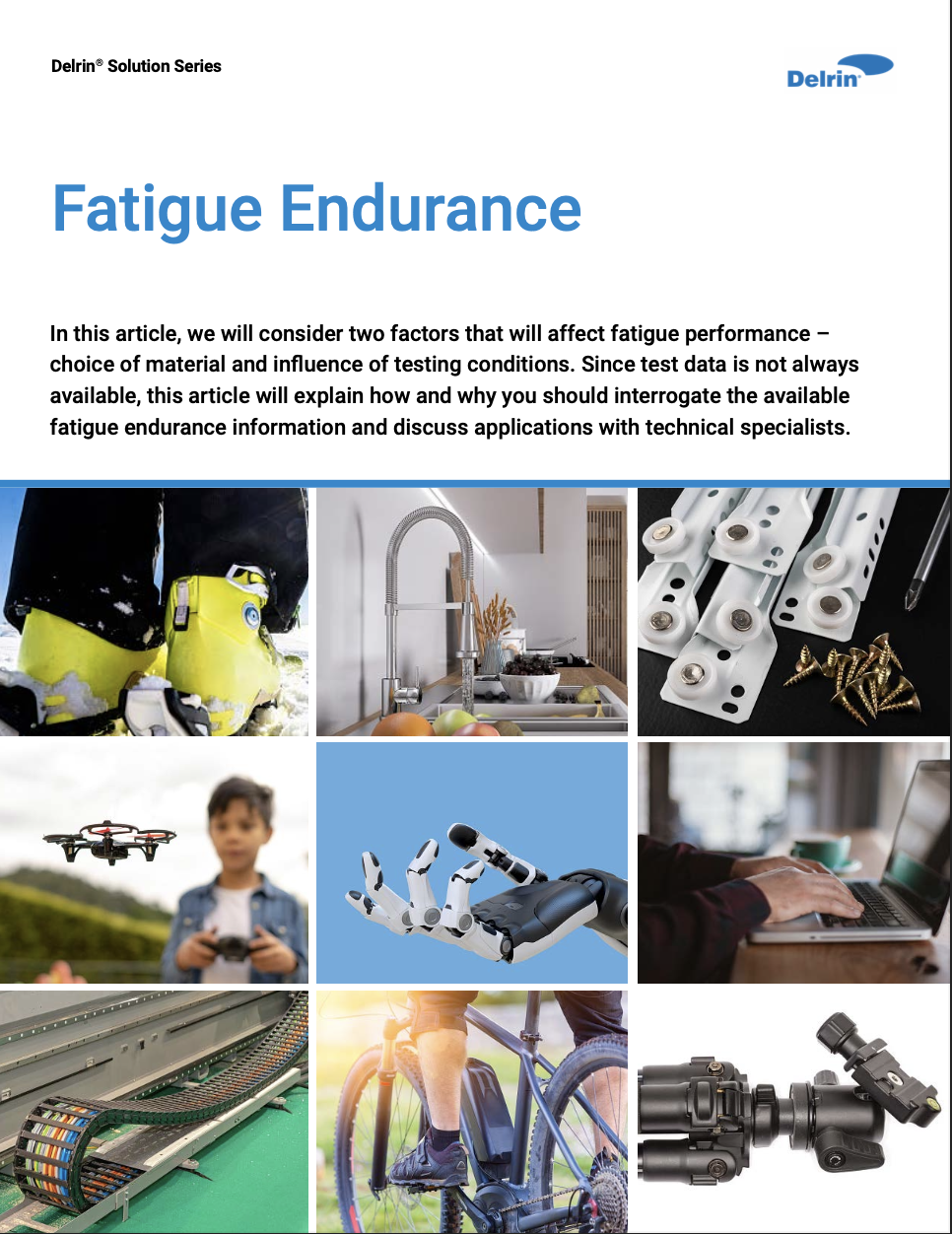
In this article, we will consider two factors that will affect fatigue performance –
choice of material and influence of testing conditions. Since test data is not always
available, this article will explain how and why you should interrogate the available
fatigue endurance information and discuss applications with technical specialists.
Delrin® Solution Series | Fatigue Endurance
What’s Inside
What is fatigue?.....................................................3
Choice of material.................................................3
Influence of testing conditions............................4
Positive stress only or fully reversed load
(shown by R number)?..........................................4
Test temperature...................................................5
Test frequency.......................................................7
Delrin® Solution Series | Fatigue Endurance
What is fatigue?
Fatigue describes the damage caused by repeated cyclical stresses or deformations whose amplitude does
not exceed the ultimate strength of the material.
Delrin® displays high fatigue resistance backed by years of service in safetycritical applications.
When presenting fatigue data, we typically look at the number of cycles to failure at a particular stress in MPa.
Stress MPa
10,000
100,000
1,000,000
10,000,000
Number of cycles to failure
Figure 1. Flexural fatigue of Delrin® 500 (ASTM D671)
Source: Delrin
Figure 1 shows a logarithmic scale for cycles to failure. If we know the stress level that a part is subjected
to, we can use the chart to determine how well the material can withstand a certain number of loading
cycles. For example, if the maximum design stress of a part is below 25MPa, fatigue should not be an issue
with this grade at 23°C.
This is a simplistic conclusion based on a single load case, and in most cases, the designer will want to
understand the performance in more detail.
Choice of material
The chart below shows a comparison of an unreinforced PA66 polyamide conditioned at 50% relative humidity
(RH) with Delrin® 500 in flexure. We can clearly see the higher maximum design stress that can be achieved
with Delrin.
45.00
40.00
Stress MPa
35.00
30.00
25.00
Delrin® 500
20.00
PA66 Cond
15.00
10.00
5.00
0.00
10,000
100,000
1,000,000
Cycles to failure
Source: Delrin
Figure 2.
Comparison of
flexural fatigue of
Delrin® at 23°C and
unreinforced PA66
(ASTM D671)
Delrin® Solution Series | Fatigue Endurance
Delrin® acetal homopolymer also shows superior fatigue performance versus a similar molecular
weight acetal copolymer.
9,000,000
8,000,000
8,000,000
Cycles to failure
7,000,000
6,000,000
5,000,000
3,700,000
4,000,000
3,000,000
2,000,000
1,000,000
22,000
15,000
General purpose
acetal copolymer
High molecular
weight acetal
copolymer
Delrin® 111DP
Delrin® 311DP
Source: Delrin
Figure 3. Comparison of flexural fatigue of Delrin® and acetal copolymer at 33MPa (ASTM D671)
Figures 2 and 3 were generated by testing in the same laboratory at the same conditions. Unfortunately,
there is only a limited amount of public data available to compare the fatigue performance of different
materials. This is because the test conditions often differ, which can have a significant effect on the results,
making direct comparisons very difficult.
Influence of testing conditions
When setting up or analyzing results from a fatigue test, the following factors need to be considered:
1. Positive stress only or fully reversed load (shown by R number)?
2. What is the nominal temperature?
3. What is the frequency of the test and what internal heat is generated?
Positive stress only or fully reversed load (shown by R number)?
Sometimes the range of stress put on a part is given by the fatigue stress ratio, R, which is the minimum fatigue
stress divided by the maximum fatigue stress: R = σmin/σmax.
This gives an indication of the total difference between the maximum and minimum stress applied to the sample.
Delrin® Solution Series | Fatigue Endurance
As can be seen in the chart below, a combination of tensile and compressive stresses from a fully reversed flexural
test (R= -1) is more damaging to the material than a flexural load applied in the same direction each time (R= 0)
resulting in a significant reduction in the permissible stress level.
60.0
50.0
Stress MPa
40.0
30.0
20.0
Load applied in same direction
23°C Tension only
Load fully reversed
23°C Tension and compression
10.0
0.0
1,000
10,000
100,000
1,000,000
Cycles to failure
Source: Delrin
Figure 4. Comparison of flexural fatigue in tension only versus tension and
compression for Delrin® 500.
An example of where this is relevant is a gear when the maximum allowable stress will be different in a gear that
always operates in one direction compared to a gear where the direction is reversed
Test temperature
In some applications, such as automotive gears, fatigue testing is conducted at elevated temperatures to
simulate real-life conditions, for example, when a vehicle’s electric windows are operated on a hot sunny day.
45.0
40.0
Stress MPa
35.0
30.0
25.0
23°C Tension and compression
20.0
66°C Tension and compression
100°C Tension and compression
15.0
10.0
5.0
1,000
10,000
100,000
1,000,000
Cycles to failure
Figure 5. Comparison of fatigue tension and compression
at different temperatures for Delrin® 500
Source: Delrin
Delrin® Solution Series | Fatigue Endurance
As would be expected, the higher the service temperature, the lower the stress level at which the material
can survive repeat loading. If elevated temperature fatigue data is not available, a good indication of
performance would be to review the change in the stress-strain curves across different temperatures. Be
sure to check what extra data the material supplier has in-house.
A good example can be seen below, comparing data for Delrin® with a standard unreinforced polybutylene
terephthalate (PBT), which has a significantly lower modulus at 40°C compared to 23°C. This change in
properties and subsequent drop in performance would also be seen when running a fatigue comparison at
those temperatures.
Stress MPa
Strain %
Delrin® 500P at 23°C
Delrin® 500P at 40°C
PBT at 23°C
PBT at 40°C
Source: CAMPUS plastics
Figure 6. Stress strain properties of Delrin® 500P
and PBT at 23°C and 40°C
Equally important is how the material performs in low temperature conditions. It is more difficult to carry
out tests at temperatures below freezing, but the low temperature impact strength gives an indication of the
material’s robustness.
Delrin® is a proven performer in cold environments with many commercial
applications in durable winter sports applications.
Delrin® Solution Series | Fatigue Endurance
Test frequency
The final point relates to the fact that repeated loading generates internal heating of the part, so the
frequency of the fatigue test should be carefully considered when comparing with the frequency of loading
of the actual part in service.
Perhaps surprisingly, temperature increases from high frequency testing can be above 15°C, meaning a
sample in a room temperature test can easily reach 40°C.
As shown previously, Delrin® is less sensitive to a temperature increase in this range compared with some
other unreinforced engineering plastics.
High frequency testing may be appropriate for a gear part with high RPM in service, but less so for a draw
roller, which in normal use would not be repeatedly opened and closed at high frequencies. In this case, the
test results recorded at high frequencies would prove too conservative, with potential consequences of overengineering the part in question. This could include designing the part with unnecessarily thick sections or
substituting a more expensive material.
The chart below shows that if a fan is used to circulate the air on the sample during the test, it allows the
part to cool more effectively. This results in a higher allowable maximum stress.
55.0
Stress MPa
50.0
With air circulation
6 MPa
Without air circulation
45.0
40.0
35.0
30.0
200,000
400,000
600,000
800,000
1,000,000
1,200,000
Cycles to failure
Source: Delrin
Figure 7. Effect of air circulation on the fatigue
performance of Delrin® when tested at 23°C
For complete data visit Delrin® Material Data Center at https://delrin.materialdatacenter.com
In summary. Delrin® is a proven material in fatigue applications, outperforming acetal copolymer, unfilled
nylon and PBT, enabling you to design parts that will last longer at higher stress levels or create lighter,
thinner wall components.
When delving into specific technical details around fatigue
endurance for your application, and which is the most appropriate
grade to select, we always recommend that you talk with Delrin
technical specialists who can provide the most relevant test
information so you can make a meaningful assessment.
Delrin® Solution Series | Fatigue Endurance
To learn more, contact your Delrin representative or visit Delrin.com.
The information and recommendations contained herein are offered as a service to our customers but are not intended to relieve the user from its
responsibility to investigate and understand other pertinent sources of information and to comply with all laws and procedures applicable to the safe
handling and use of these materials. The information and recommendations provided herein were believed by Delrin® to be accurate at the time of
preparation or obtained from sources believed to be generally reliable. However, Delrin® makes no warranty concerning their accuracy and Delrin® will not
be liable for claims resulting from any party’s use of or reliance on information or recommendations contained herein regardless of whether it is claimed
that the information or recommendations are inaccurate, incomplete or otherwise misleading. Caution: For medical applications, discuss with a Delrin
customer representative and consult the Delrin® Medical Caution Statement.
Delrin is an industry-leading premium industrial polymer business. Grounded in strong innovation, Delrin is a category creator with a longstanding
reputation for quality, reliability, supply and product performance. The iconic Delrin brand, coupled with proprietary technology and deep application
expertise make us a leader in the high-end engineering polymer market. Delrin has exciting growth prospects from exposure to automation, actuation,
healthcare, mobility and consumer applications.
Copyright 2024 Delrin®
Form No. HMC0624